
AC Capacitor Failure in Gilbert, AZ
AC capacitor failure is common in Gilbert heat. Learn the signs, why DIY is risky, and how Sunset replaces capacitors safely and fast.
 By Sean · HVAC
Free estimates • Honest second opinions •Licensed, bonded & insured
In this article
If your AC stops blowing cold air, the most likely culprit is a failed HVAC capacitor, a common issue in our intense Arizona heat. When you're facing an AC capacitor failure in Gilbert, AZ, the only solution is a rapid, expert diagnosis and replacement by an AC repair technician. Sunset Home Services provides this essential service to homeowners across Gilbert and the East Valley, restoring your home's comfort quickly and honestly.
Table of Contents
- What Does an AC Capacitor Actually Do?
- Why Does Extreme Heat Cause AC Capacitor Failure in Gilbert, AZ?
- What Are the Signs of a Failing AC Capacitor?
- What Should I Do If My AC Capacitor Has Failed?
- How Can I Protect My AC Capacitor?
- Get Expert AC Capacitor Replacement in Gilbert, AZ
- Frequently Asked Questions
That sudden, unnerving silence when your air conditioner should be humming is a classic Gilbert summer experience. The fan outside might not be spinning, or maybe it’s just humming weakly. More often than not, the problem isn't a catastrophic system failure but a small, overworked component: the AC capacitor. According to Sapper HVAC, capacitor failure is the single most common AC repair call in Arizona, happening here more than anywhere else in the country. Understanding what this part does and why our climate is so tough on it is the first step to a fast solution.
What Does an AC Capacitor Actually Do?
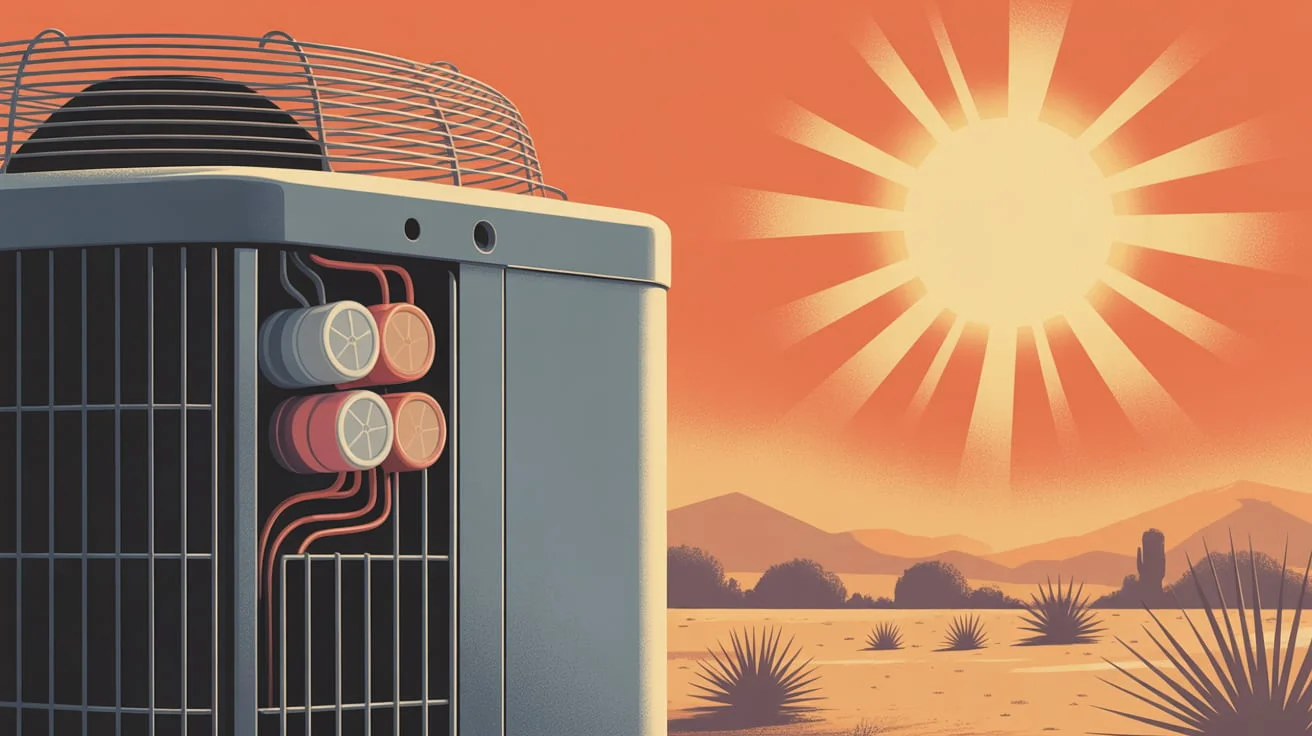
An AC capacitor is a small, cylindrical component that acts like a short-term battery for the motors in your air conditioning unit. Its primary job is to store and discharge a significant electrical charge to provide the initial torque needed to start the compressor, the outdoor condenser fan motor, and the indoor blower motor. Once the motors are running, a "run capacitor" provides a smaller, steady supply of energy to keep them spinning efficiently.
Think of it like pushing a stalled car. It takes a big, coordinated shove to get it rolling, but much less effort to keep it moving. The capacitor delivers that initial, powerful shove. Without a fully functional capacitor, the motors can't overcome inertia to start, leading to the humming sound of a motor trying—and failing—to engage.
Why Does Extreme Heat Cause AC Capacitor Failure in Gilbert, AZ?
The primary reason for AC capacitor failure in Gilbert is our extreme heat, which pushes the component beyond its designed operating limits and drastically shortens its life. Most residential AC capacitors have a maximum operating temperature rating of around 70°C (158°F). As Sapper HVAC notes, ambient temperatures in our area can reach 115–125°F in July. Inside a dark metal box sitting in direct sunlight, the internal temperature of your AC unit can easily approach or exceed that 158°F limit.
This intense heat accelerates the chemical degradation of the materials inside the capacitor. This principle is known as the Arrhenius degradation mechanism, which, as explained by Top Notch Air Conditioning & Heating, states that for every 10°C (18°F) increase in operating temperature, a capacitor's service life is roughly cut in half.
Combine this with the sheer workload. During peak summer, AC systems across the Phoenix metro area often run for 12-16 hours daily, according to data from Parker & Sons and Bucksworth Home Services. This constant cycling under extreme thermal stress is why a capacitor that might last 5-10 years in a moderate climate may only survive 2-3 years here in Arizona, as noted by Airtron Heating & Air.
What Are the Signs of a Failing AC Capacitor?
A failing AC capacitor often gives clear warning signs before it quits completely, and recognizing them can help you avoid a total system shutdown on the hottest day of the year. The most obvious sign is that your AC unit won't start; you might hear a humming or clicking noise from the outdoor unit, but the fan and compressor never kick on. The fan might also start slowly or need a manual push to get going (do not attempt this).
Other symptoms
- AC blows warm air: The indoor blower may work, but without the compressor and outdoor fan running, no heat is being removed from your home. If the air is cool but weak instead, the cause is more often airflow or leaky ductwork than the capacitor.
- Intermittent shutdowns: The unit may start, run for a short period, and then shut off unexpectedly.
- Increased energy bills: A weak capacitor forces the motors to work harder, drawing more electricity and reducing system efficiency.
If you inspect the outdoor unit (with the power turned off at the breaker), you may see physical evidence. A failed capacitor often has a swollen or bulging top, which should be perfectly flat. It might also be leaking an oily substance. According to HVACProSales, a multimeter test showing a capacitance reading more than 5% below its rated capacity confirms the need for replacement.
What Should I Do If My AC Capacitor Has Failed?
If you suspect an AC capacitor failure in Gilbert, AZ, the first step is to turn your air conditioning system off at the thermostat to prevent potential damage to the compressor motor. A motor that repeatedly tries to start against a bad capacitor can overheat and burn out, turning a simple repair into a full system replacement. Then, call a qualified HVAC professional.
While some homeowners may consider a DIY replacement, it's a job that carries significant risks. Capacitors store a powerful electrical charge even when the power is off, and mishandling them can result in severe electrical shock.
Professional vs. DIY Capacitor Replacement
A trained technician can diagnose the problem correctly, safely replace the part, and ensure your system is running optimally.
| DIY Approach | Sunset Home Services Professional | |
|---|---|---|
| Safety | High risk of electrical shock if not discharged properly. | Trained in safe handling and discharging procedures. Fully insured. |
| Part Selection | Risk of buying the wrong part. Incorrect specs can damage the AC. | Guarantees the correct part, matching the microfarad (μF) rating within ±5% and using an equal or higher voltage rating, per industry best practices. |
| Diagnosis | Assumes the capacitor is the only issue. May miss underlying problems. | Performs a full system check to confirm the diagnosis and identify other potential issues (e.g., a failing fan motor that caused the capacitor to fail). |
| Tools | Requires specialized tools like a multimeter that can read capacitance. | Arrives with all necessary professional-grade tools for diagnosis and repair. |
| Warranty | No warranty on labor. Part warranty may be voided by improper installation. | We stand behind our work with a full warranty on both the part and our labor. |
Honest second opinion
Not sure you need a full replacement?
Sunset Home Services gives free second opinions across Gilbert and the East Valley. We'll tell you what actually failed and whether a repair is still the right call.
How Can I Protect My AC Capacitor?
While you can't change the Gilbert weather, you can take steps to protect your HVAC system and its components. The single most effective action is scheduling regular, professional maintenance. During a tune-up, a technician will test your capacitor's performance. A capacitor that is testing weak can be replaced proactively before it fails and leaves you without cooling.
Other protective measures
- Providing Shade: If possible, shading your outdoor unit from direct afternoon sun can lower its operating temperature.
- Keeping it Clean: Ensure the area around your condenser is free of debris, leaves, and dirt to allow for maximum airflow, which helps the unit dissipate heat more effectively.
- Upgrading to a Hard-Start Kit: For older units, a hard-start kit can be installed. This is essentially a more powerful start capacitor that assists the primary capacitor, reducing strain and extending its life.
Your indoor blower motor runs in heating mode too, so the same tune-up that protects your cooling season also catches the start-up faults behind furnace trouble across Gilbert and the East Valley once the weather turns.
Get Expert AC Capacitor Replacement in Gilbert, AZ
When your AC goes down in the middle of an Arizona summer, you need fast, reliable service from a team you can trust. At Sunset Home Services, we don't just replace parts; we provide honest diagnoses and lasting solutions. Our experienced technicians are equipped to handle any residential AC repair, from a simple capacitor swap to more complex issues.
We provide clear, upfront pricing and ensure the job is done right the first time, using high-quality parts that meet or exceed manufacturer specifications. If you're experiencing an AC capacitor failure or any other cooling issue, trust the local experts who understand the demands of our climate. We are proud to offer comprehensive services for homeowners in Gilbert and throughout the East Valley, including Chandler, Mesa, and Queen Creek.
Don't wait for the heat to become unbearable. Contact Sunset Home Services at (480) 599-5086 today for a quick and professional solution to get your cool air flowing again.
Frequently asked questions
What does an AC capacitor look like?
An AC capacitor is typically a metal cylinder, often silver, black, or gray, about the size of a soda can. You will find it in the outdoor condenser unit near the compressor. Some units have a single dual-run capacitor, while others may have two separate capacitors for the compressor and fan motor.
How long does it take to replace an AC capacitor?
A straightforward capacitor replacement is a quick job for a trained professional. The entire service call, including diagnosis, safely discharging the old capacitor, installing the new one, and testing the system, typically takes less than an hour.
Can a bad capacitor damage my AC compressor?
Yes. A failing capacitor can cause significant damage to other, more expensive components. When a capacitor is weak, the compressor and fan motors struggle to start, drawing excess current and generating heat. This strain can lead to motor burnout, turning a relatively inexpensive repair into a major system replacement.
Is a humming sound from my AC unit always a bad capacitor?
While a humming noise is a classic symptom of a bad capacitor, it can also indicate other issues, such as a seized motor or a contactor problem. A professional diagnosis is necessary to pinpoint the exact cause and prevent unnecessary repairs or further damage.
How much does it cost to replace an AC capacitor in Arizona?
The cost involves both the part and the labor for the service call. While the capacitor itself is not an expensive component, the price reflects the expertise required for a safe and correct installation, professional diagnosis, and the convenience of a rapid emergency response. Contact us for a clear, upfront quote.
Can I just replace my capacitor with a bigger one?
No, this is a common and costly mistake. You must replace a capacitor with one that has the exact same microfarad (μF) rating (or within ±5%, according to HVAC School). You can use a capacitor with an equal or higher voltage rating, but never a lower one. Using the wrong μF rating will cause the motor to run inefficiently and fail prematurely.
Related Sunset services
Need hands-on help? These are the services most relevant to this article.
- AC RepairAC not cooling? Fast, accurate diagnosis and honest repair options.View service
- HVAC MaintenanceTune-ups that keep your system efficient through the AZ summer.View service
- AC Installation & ReplacementRight-sized, properly installed AC and heating systems that last.View service
- Ductwork Servicing & CleaningSeal leaks and clear ducts for better airflow and lower bills.View service
- Mini Split SystemsDuctless comfort for garages, additions, and hard-to-cool rooms.View service
Keep reading
- HVAC 7 min read
AC Running But Not Cooling in Gilbert, AZ
AC running but not cooling in Gilbert? Common causes: clogged filters, failed capacitors, low refrigerant. What to check before you call Sunset.
By Sean · Read more - HVAC 7 min read
Repair or Replace? How to Decide When Your Arizona AC Fails
Before you spend thousands on a new system, here's how to tell whether your AC is worth repairing, the red flags to watch for, and the questions to ask any contractor first.
By Sean · Read more - HVAC 7 min read
Pro AC Installation in Gilbert, AZ: Buyer's Guide
Need a new AC installation in Gilbert, AZ? Our 2026 guide covers system sizing (Manual J), SEER2 ratings, and new refrigerants for lasting home comfort.
By Sean · Read more