
When to Replace an Aging AC
Repairs stacking up on an older air conditioner? How to tell, and when a right-sized install is the honest next step.
 By Sean · HVAC
Free estimates • Honest second opinions •Licensed, bonded & insured
In this article
An older air conditioner usually warns you before it quits. Repairs that keep coming back, a unit that is 12 to 15 years old or more, or summer bills that climb for no clear reason are the usual signs. The installation itself is booked on our AC installation and replacement page. This article is the decision guide, not the service page.
Replacing an air conditioner is a big decision, and we'd rather you make it with clear information than under pressure. At Sunset Home Services, we start by finding out whether a repair still makes sense. This guide walks through the same questions we help Gilbert and East Valley homeowners answer every summer.
Table of contents
Signs It's Time for an AC Replacement
Most air conditioners give you plenty of warning before they quit for good. Age is the first clue. Arizona summers are hard on equipment, and a unit that has been running for 12 to 15 years is getting close to the end of its working life.
Beyond age, pay attention to the pattern. If you're calling for a repair every summer and the bills keep growing, that money may do more good going toward a new, dependable system. A big jump in your electric bill with no change in how you use the house is another sign the system is losing efficiency. And if your unit still runs on R-22 refrigerant (often called Freon), plan ahead: R-22 has been phased out, so it's expensive and hard to find when a repair calls for it.
A few other things worth noticing
- New noises: Grinding, squealing, or banging usually points to a mechanical problem that needs a look soon.
- Stuffy or dusty air: More dust, a musty smell, or air that feels damp can mean the system isn't filtering or moving air the way it should.
- Hot and cold rooms: If one bedroom is freezing and another never cools down, the system may be struggling to move air through the house.
Any one of these can often be fixed. Several of them together on an older unit is when replacement starts to make more sense. If you're not sure, start with a diagnosis. A good technician will tell you honestly whether an AC repair in Gilbert will buy you a few more good years, or whether you'd be putting money into a system that's on its way out. We also wrote a longer guide on whether to repair or replace your AC in Arizona.
How Does the Repair vs. Replace Decision Work?
Many people in the HVAC trade use a rule of thumb called the "$5,000 rule." Multiply the repair estimate by the age of your unit in years. If the result is more than $5,000, replacement is usually the better long-term choice. For example, a $600 repair on a 10-year-old unit works out to $6,000, which suggests a new system is the smarter spend.
It's a guideline, not a law. If your system has been well maintained and the repair is small, fixing it can still be the right call even when the math lands a little over the line. The point is to avoid pouring money into a unit that's likely to break again soon.
What Should You Look for in a New AC System?
The brand name on the side of the unit matters less than three things: size (tonnage), efficiency (SEER2 rating), and type (single-stage, two-stage, or variable-speed). Getting those right is what keeps you comfortable and your bills under control.
Sizing should start with a load calculation, sometimes called a Manual J. It looks at your home's square footage, insulation, windows, and sun exposure to figure out how much cooling the house actually needs, rather than guessing from the size of the old unit.
Once the size is set, you can compare system types against your budget and how much comfort matters to you.
| Single-Stage | Two-Stage | Variable-Speed (Inverter) | |
|---|---|---|---|
| Operation | Runs at full capacity or is off. | Runs on a low or a high setting. | Adjusts in small steps and runs steadily at low speed most of the time. |
| Comfort | Basic cooling, with noticeable temperature swings. | More even temperatures and better humidity control. | The most even temperature and humidity control. |
| Efficiency | Lowest of the three. | Better, since it spends most of its time on the low setting. | Highest, which usually means the lowest running costs. |
| Upfront Cost | Lowest | Moderate | Highest |
Honest second opinion
Not sure you need a full replacement?
Sunset Home Services gives free second opinions across Gilbert and the East Valley. We'll tell you what actually failed and whether a repair is still the right call.
What a careful replacement includes
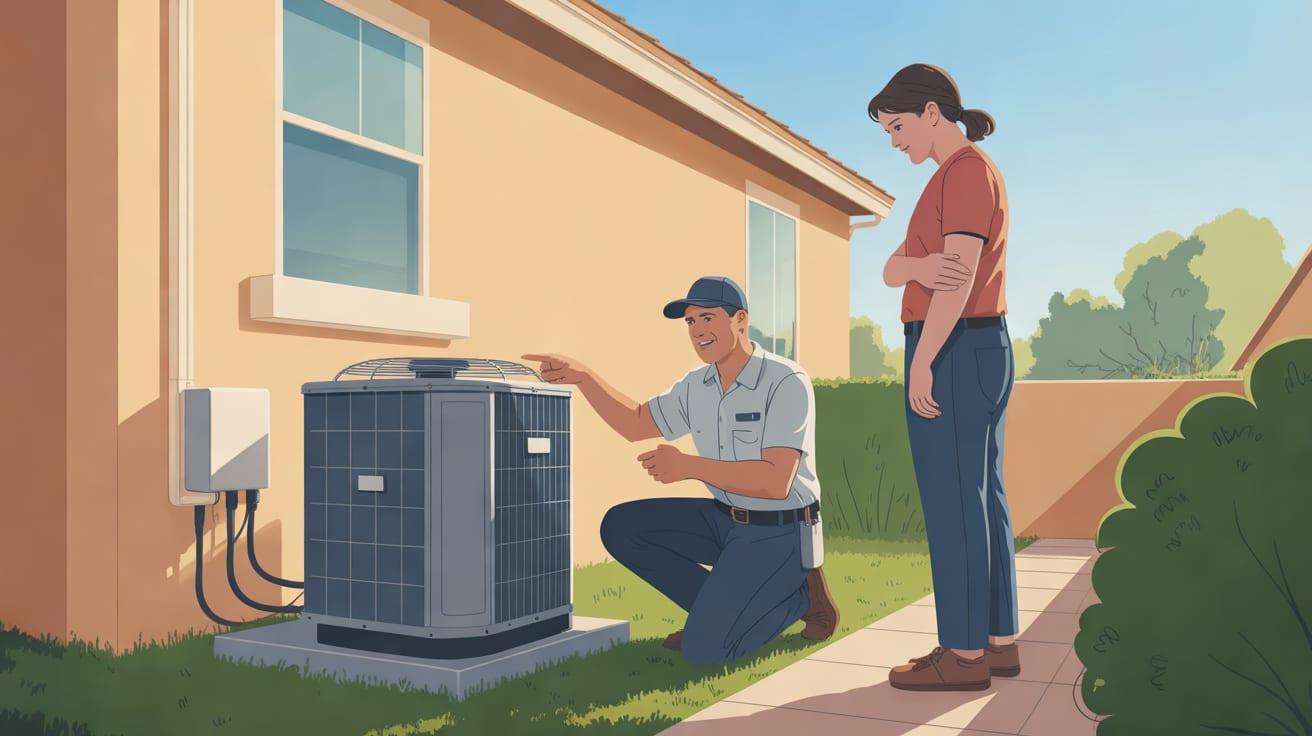
An honest replacement comes down to clear information, careful work, and no pressure. We believe the quality of the installation matters more than the brand you choose. A top-of-the-line system installed poorly will give you trouble, while a standard system installed well can run reliably for years.
That's why our AC installation and replacement process starts with a load calculation and a look at your ductwork for leaks and restrictions before we quote. Leaky or undersized ducts can hold back even a brand-new system, so it's worth knowing before you buy. You'll get straight talk on the efficiency options, from standard to variable-speed, and an upfront price you approve before any work starts. We're a family-owned, licensed, bonded and insured local team, and the same care goes into all of our HVAC services.
What Happens on Installation Day?
A typical like-for-like replacement takes about one day. Jobs that need new ductwork or electrical upgrades can run longer, and we'll tell you up front if yours might.
Roughly how the day goes
- The old indoor and outdoor units are disconnected, and the refrigerant is recovered properly as EPA rules require.
- The new outdoor unit is set on a level pad and the new indoor equipment is put in place.
- The ductwork, wiring, and refrigerant lines are connected and checked for leaks, then the lines are vacuumed to remove air and moisture.
- The system is charged with refrigerant, and we verify airflow, refrigerant charge, and temperatures at startup so it runs right from day one.
- We clean up and answer any questions you have about your new system.
We do this for homeowners in Gilbert, AZ and across the East Valley.
Your home deserves cooling you can count on, especially in an Arizona summer. If you're stuck between repairing and replacing, give us a call. We'll take an honest look, explain what we find, and help you decide without any pressure.
Sunset Home Services, Gilbert, AZ, (480) 599-5086
Frequently asked questions
How much does it cost to replace an AC unit in Arizona?
It depends on the size of the system, its efficiency rating, the type of equipment, and how involved the installation is (for example, whether ductwork or electrical work is needed). The only way to get a real number is an in-home estimate that includes a load calculation. We give you an upfront price to approve before any work starts.
What is the $5,000 rule for an AC unit?
It's a rule of thumb for deciding between repair and replacement. Multiply the repair cost by the unit's age in years. If the total is more than $5,000, replacement is often the better long-term choice. For example, a $700 repair on a 9-year-old unit comes to $6,300, which points toward replacing.
How do I know what size AC my 2,000 sq ft house needs?
Square footage is only part of the picture. A load calculation also looks at insulation, windows, ceiling height, and sun exposure, so two 2,000 sq ft homes can need different sizes. Be cautious with any quote based on square footage alone.
What AC brands should you stay away from?
The installer matters more than the brand. Most major manufacturers make dependable equipment. What makes the difference is a contractor who sizes the system correctly, installs it carefully, and stands behind the work.
How long does an AC replacement take?
A straightforward like-for-like replacement usually takes about one day. Jobs that need new ductwork, electrical upgrades, or moving equipment can take longer.
Should I replace my furnace at the same time as my AC?
If your furnace or air handler is about as old as your air conditioner, it's often worth replacing them together. The indoor and outdoor parts are designed to work as a matched system, and pairing new with old can cost you efficiency and comfort. If the indoor equipment is newer and in good shape, keeping it may be fine; we'll tell you honestly which applies to your home.
What is a SEER2 rating?
SEER2 measures how efficiently an air conditioner cools over a typical season. The higher the number, the less electricity it uses for the same cooling. Since January 2023, the federal minimum for most new home-size central air conditioners in the Southwest, including Arizona, is 14.3 SEER2. Higher-efficiency systems cost more up front but can lower your summer bills.
Related Sunset services
Need hands-on help? These are the services most relevant to this article.
- AC RepairAC not cooling? Fast, accurate diagnosis and honest repair options.View service
- HVAC MaintenanceTune-ups that keep your system efficient through the AZ summer.View service
- AC Installation & ReplacementRight-sized, properly installed AC and heating systems that last.View service
- Ductwork Servicing & CleaningSeal leaks and clear ducts for better airflow and lower bills.View service
- Mini Split SystemsDuctless comfort for garages, additions, and hard-to-cool rooms.View service
Keep reading
- HVAC 7 min read
What AC Install Day Looks Like
What a careful installation day includes, from sizing to startup, for Gilbert and East Valley homes.
By Sean · Read more - HVAC 7 min read
Repair or Replace? How to Decide When Your Arizona AC Fails
Before you spend thousands on a new system, here's how to tell whether your AC is worth repairing, the red flags to watch for, and the questions to ask any contractor first.
By Sean · Read more - HVAC 7 min read
Before You Buy a New AC in Gilbert
What to check before a new system in Gilbert: load, ducts, efficiency, and a straight installation.
By Sean · Read more