
Signs Your Water Heater Is Done
Rusty hot water, a rumbling tank, or a puddle that keeps coming back. Here's how to tell whether your water heater is worth repairing, and what an honest replacement in Gilbert actually involves.
 By Matt · Plumbing
Free estimates • Honest second opinions •Licensed, bonded & insured
In this article
A water heater usually gives you warning before it quits. Rusty hot water, a rumble when the burner fires, a small puddle that keeps coming back. The hard part is knowing which of those signs means a straightforward repair and which one means the tank is finished.
This guide covers the signs worth acting on, what can still be repaired, how the common system types compare, and what a code-compliant replacement actually involves in Gilbert and the East Valley. No scare tactics, and no pressure to replace something that still has life in it.
How to tell your water heater is done
Age is the most reliable single signal. Manufacturers generally put a traditional storage tank at 8 to 12 years of service life, and in our experience, Arizona's mineral-heavy water tends to push units toward the low end of that range. Tankless units, maintained properly, often run 15 to 20 years or more.
Age alone isn't a reason to replace anything. What matters is age combined with what the unit is actually doing. One failed part on a seven-year-old tank is a repair. Rusty water and a puddle under a twelve-year-old tank is a replacement, and spending money on it only delays the same conversation.
Signs it's more than a small repair
- Rusty or discolored water from the hot tap only
- Rumbling or popping while the burner is running
- Water pooling at the base of the tank
- Hot water that runs out much faster than it used to
- A unit past 10 years that needs another repair
Why Gilbert's hard water matters here
The Town of Gilbert reports average water hardness around 8 to 10 grains per gallon, which lands squarely in the hard range. Calcium and magnesium drop out of solution inside a hot tank and settle at the bottom as sediment, where they harden into a layer of scale sitting between the burner and the water it's supposed to heat.
That layer is what causes the rumbling and popping you hear. It forces the burner to run longer for the same amount of hot water, drives up the gas or electric bill, and stresses the steel at the bottom of the tank until it fails early. Flushing the tank on a schedule slows that down. Treating the water slows it down further.
What can be repaired instead of replaced
Plenty of water heater failures are component failures, not tank failures. A thermocouple on a gas unit, a heating element or thermostat on an electric one, a leaking temperature and pressure relief valve, or a spent anode rod are all normal wear items with straightforward fixes.
The anode rod is worth knowing about. It's a sacrificial metal rod that corrodes so your tank doesn't, and replacing it every few years on an otherwise healthy unit can add real life to the heater. What can't be repaired is the tank itself. Once the steel is breached, water is going to find its way out, and no patch is a safe answer.
Repair or replace, at a glance
Repair usually makes sense when
- The tank is under about eight years old
- A single part failed, like a thermocouple or element
- The leak is at a fitting or valve, not the tank body
- The unit has been flushed and maintained
- Hot water is otherwise steady and adequate
Replacement is the honest call when
- The tank body itself is leaking or rusted through
- Hot water runs rusty or discolored
- The unit is past 10 to 12 years and failing again
- Repairs are stacking up on an inefficient tank
- The heater can no longer keep up with the household
Choosing the right type of water heater
If replacement is the right call, the next decision is what goes back in. Most Gilbert homes are choosing between a traditional storage tank, a tankless on-demand unit, and a heat pump (hybrid) model. The right answer depends on your hot water demand, the space you have, and how long you plan to stay in the house.
Storage tanks are the least expensive to install and the simplest to service. Tankless units cost more up front but last longer and don't run out mid-shower. Heat pump models pull heat out of the surrounding air, which works well in an Arizona garage, and they run at a fraction of the operating cost of a standard electric tank.
| Storage tank | Tankless | Heat pump | |
|---|---|---|---|
| Upfront cost | Lowest | Higher | Highest |
| Operating cost | Moderate to high | Low to moderate | Lowest |
| Hot water supply | Limited by tank size | Continuous, limited by flow rate | Tank size, slower recovery |
| Typical lifespan | 8 to 12 years | 15 to 20+ years | 10 to 15 years |
| Space needed | Full floor footprint | Compact, wall-mounted | Footprint plus air clearance |
Efficiency rules that are changing
Federal minimum efficiency standards are tightening, and it helps to know where they're headed before you buy. Residential electric storage water heaters over 35 gallons that are manufactured on or after May 6, 2029 will effectively need heat pump technology to meet the federal minimum. That rule applies to newly built units, not to a water heater you already own, so nobody is required to replace a working tank because of it.
There is a commercial-side change too, and it shows the same trend. A rule finalized in October 2023 raises the minimum thermal efficiency for most commercial gas storage water heaters from 80% to 95%, which effectively requires condensing equipment. It applies to units manufactured or imported on or after October 6, 2026, though the Department of Energy announced in April 2026 that it would delay enforcement for a year, and the compliance date is the subject of a pending rulemaking petition. If you own commercial property, check where that rule stands before you plan a replacement.
What a code-compliant replacement involves
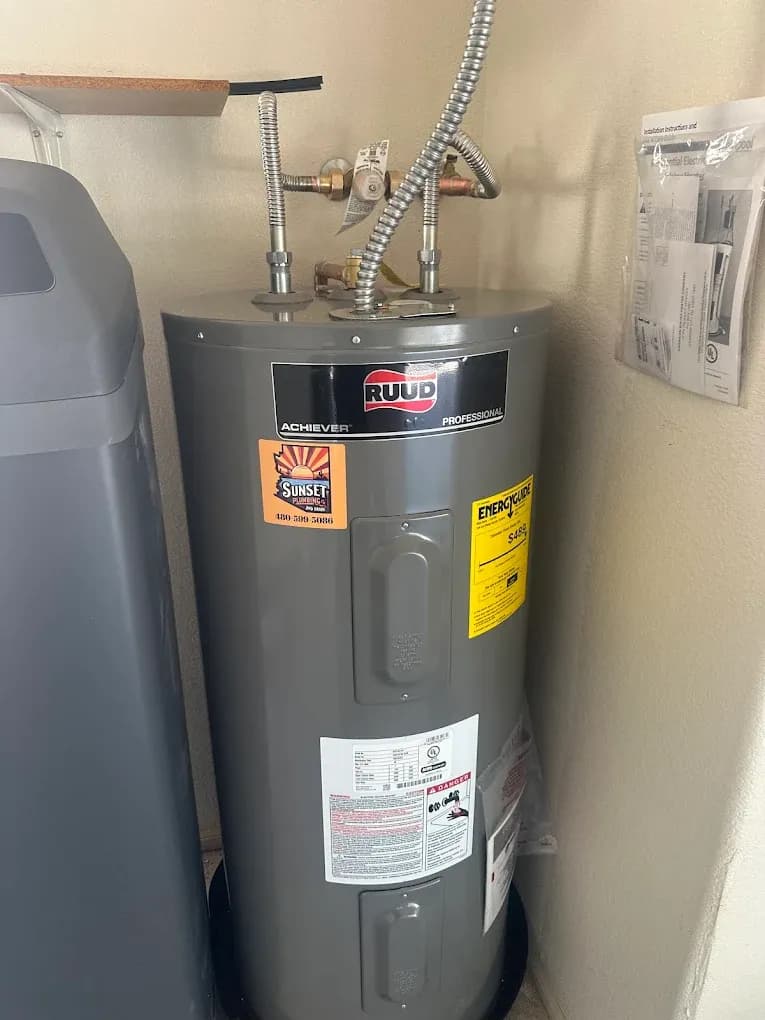
A water heater changeout is a systematic job, not a swap. The old unit gets isolated, drained, and hauled out. The set space gets cleaned and leveled. The new heater goes in with proper water and fuel connections, and then the details an inspector will actually look at get handled.
The big one is thermal expansion control. If your cold supply has a check valve, a pressure-reducing valve, or a backflow preventer on it, you're on a closed system, and codes such as IPC 607.3 require a device, usually a small expansion tank, to absorb the pressure that heated water creates. Without it, that pressure works against your pipes, your fixtures, and the new heater's own relief valve. Venting, the drain pan, and the relief valve discharge line get verified the same way. Gilbert's plumbing code amendments also call for a galvanized steel drain pan when a storage tank sits in an attic or a furred space where a leak would cause damage.
What a proper replacement includes
- Shutting off water, gas or power, and draining the old tank
- Removing the old unit and prepping a clean, level set space
- Setting the new heater and making the water and fuel connections
- Installing a thermal expansion tank where the system requires one
- Verifying venting, the drain pan, and the relief valve discharge line
- Filling, leak checking, firing the unit, and setting it near 120 degrees
Honest second opinion
Told you need a new water heater?
Sunset Home Services gives free second opinions across Gilbert and the East Valley. We'll tell you what actually failed and whether a repair is still the right call.
Why a local licensed plumber matters
A big-box installer or a general handyman can set a tank. What they often miss is the local layer: the permit path for your specific jurisdiction, the expansion tank and drain pan requirements, the venting detail an inspector will check, and what Arizona water is going to do to the unit over the next decade.
It also matters who you can call when something isn't right six months later. We're licensed, bonded, and insured in Arizona under ROC #352779 and #359549, and we work in Gilbert, Chandler, Queen Creek, and the rest of the East Valley every day. If a new heater underperforms, we're the ones who come back.
Making the call on your own heater
Replace when the tank is leaking, when the hot water runs rusty, or when an aging unit is stacking up repairs it won't recover from. Repair when a single component failed and the tank is sound. That's the whole framework, and any plumber should be willing to walk you through which one you're looking at and why.
If someone told you the heater is finished and the number caught you off guard, get a second look before you sign. We give free second opinions across Gilbert and the East Valley, and there's no cost to finding out where you actually stand.
Frequently asked questions
How long does a typical water heater replacement take?
In our experience, a standard water heater replacement, from draining the old unit to testing the new one, takes about 2 to 4 hours. Limited access, necessary plumbing modifications, or bringing the installation up to current code can extend that timeframe.
How does Gilbert's hard water affect my water heater?
Gilbert's hard water carries calcium and magnesium that settle at the bottom of the tank as sediment. That buildup forces the heater to work harder, cuts efficiency, and can shorten the tank's life. Flushing the tank on a schedule helps, and water treatment helps more.
Should I get a tankless water heater in Arizona?
Tankless units suit a lot of Arizona homes. They're efficient, they supply continuous hot water, and they typically last 15 to 20 years or more. The upfront cost is higher, so it comes down to your hot water demand and how long you plan to stay in the house.
What is a thermal expansion tank and why do I need one?
It's a small secondary tank that absorbs the pressure created when water heats up in a closed plumbing system. Codes such as IPC 607.3 require an expansion control device on those systems to protect your pipes, fixtures, and the water heater's own relief valve.
Related Sunset services
Need hands-on help? These are the services most relevant to this article.
- Water Heater Repair & ReplacementNo hot water or a leaking tank? Repair or right-size a new unit.View service
- Water TreatmentSofteners and filtration to tame Arizona's hard water and buildup.View service
- General PlumbingLeaks, low water pressure, repairs, and installs handled right the first time.View service
- Fixture Repair & ReplacementFaucets, toilets, disposals, and fixtures repaired or upgraded.View service
- Drain CleaningClear slow or clogged kitchen, bath, and main-line drains fast.View service
Keep reading
- Plumbing 5 min read
Why Your Drains Keep Clogging (and When to Call a Plumber)
A drain that clogs again a week after you cleared it is trying to tell you something. Here's what repeat clogs usually mean and when it's time to call.
By Matt · Read more - Second Opinions 5 min read
Getting a Second Opinion on a Big Home Repair: What to Ask
A second opinion on a major plumbing or HVAC repair can save you thousands. Here's how to get one that actually helps.
By Sean · Read more - HVAC 7 min read
Repair or Replace? How to Decide When Your Arizona AC Fails
Before you spend thousands on a new system, here's how to tell whether your AC is worth repairing, the red flags to watch for, and the questions to ask any contractor first.
By Sean · Read more