
AC Capacitor Failure Gilbert AZ
Discover why extreme summer heat causes AC capacitor failure in Gilbert, AZ. Learn warning signs and why professional repair is key for lasting comfort.
 By Sean · HVAC
Free estimates • Honest second opinions •Licensed, bonded & insured
In this article
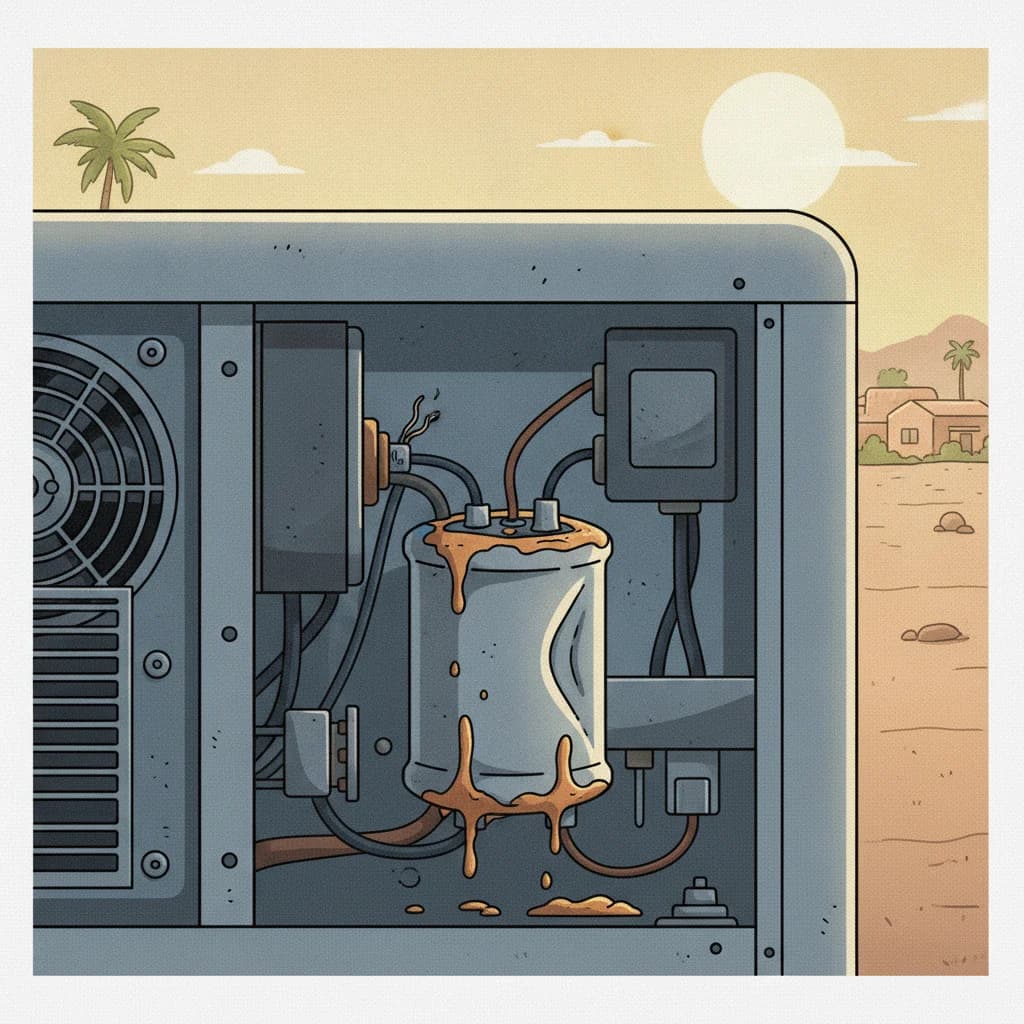
For homeowners in our area, AC capacitor failure in Gilbert, AZ, is an all-too-common problem, and the primary cause is the intense and prolonged summer heat. These vital components, which start and run your AC's motors, degrade prematurely under extreme temperatures. This leads to a loss of cooling capacity and eventual system breakdown, leaving your home unprotected from the heat.
Table of contents
What Is an AC Capacitor and What Does It Do?
An AC capacitor is a small, cylindrical component in your outdoor condenser unit that acts like a short-term battery. Its job is to store and release a powerful burst of electricity. This energy is essential to provide the initial torque needed to start the compressor, outdoor fan motor, and sometimes the indoor blower motor. Once the motors are spinning, the capacitor continues to provide a steady supply of energy to keep them running efficiently.
Think of it like trying to spin a heavy merry-go-round. The first push takes the most effort. The capacitor provides that massive initial push. Without it, the motor just doesn't have the rotational force to overcome its own inertia and will often just hum in place.
There are two main types you might encounter
- Start Capacitors: Provide the initial jolt to get the motor started, then disconnect from the circuit.
- Run Capacitors: Remain in the circuit to help the motor run smoothly and efficiently throughout the cooling cycle.
Many modern residential systems use a dual-run capacitor, which is two capacitors combined into one unit to serve both the compressor and the fan motor.
Why Heat Causes AC Capacitor Failure in Gilbert, AZ
Excessive operating temperature is the primary reason capacitors fail, creating a destructive feedback loop perfect for our climate. According to research from sources like ICM Controls and Specap, Inc., heat directly attacks the capacitor's internal components. The dielectric material, an oily fluid that insulates the conductive plates inside, begins to break down chemically when overheated.
This degradation causes two critical problems
- Reduced Capacitance: The unit's ability to store an electrical charge (measured in microfarads, MFD) diminishes. The motor receives less starting power, causing it to struggle and draw more current, which generates even more heat.
- Increased ESR: The Equivalent Series Resistance (ESR), a measure of internal resistance, goes up. Higher ESR means more of the capacitor's energy is lost as heat instead of being delivered to the motor. This extra heat further accelerates the breakdown of the dielectric material.
Standard AC capacitors are typically rated for a maximum operating temperature of 70°C (158°F). Specap, Inc. notes that a capacitor's lifespan is cut significantly for every 10°C rise above that rated temperature. On a 115°F day in Gilbert, the metal box of your outdoor unit can easily reach and exceed that 158°F threshold, putting immense stress on the capacitor every time it runs.
What Are the Warning Signs of a Failing Capacitor?
A failing capacitor gives off several distinct clues before it quits entirely. Paying attention to these signs can help you schedule a repair before you're left with a complete system breakdown on the hottest day of the year. According to multiple HVAC service guides, including those from Franklin and Beacon Services & Appliances, you should watch for these common indicators:
- Humming, Not Starting: You hear a humming or buzzing sound from the outdoor unit, but the fan blade isn't spinning and the compressor won't kick on.
- Warm air from vents: The indoor unit's fan may be running and blowing air, but because the outdoor unit isn't working, the air is not being cooled.
- Delayed Startup: The AC takes an unusually long time to start after the thermostat calls for cooling.
- Intermittent Operation (Short Cycling): The system starts and stops frequently without completing a full cooling cycle.
- Tripped Breakers: The struggling motors pull excessive amperage, causing the circuit breaker to trip repeatedly.
- Visible Damage: You may see the top of the capacitor bulging or swelling. In some cases, you might see fluid leaking from it. If you see this, turn the system off immediately.
If you notice any of these symptoms, it's time to call for a professional diagnosis. Continuing to run your AC with a weak capacitor can cause permanent damage to the far more expensive compressor and fan motors.
Can I Prevent My AC Capacitor from Failing?
While you can't completely prevent component failure in our harsh climate, you can take proactive steps to extend the life of your capacitor and your entire HVAC system. The most effective strategy is consistent professional maintenance. The HVAC Capacitor Safety Guide emphasizes that periodic inspection is a key preventive practice.
During a professional tune-up, a technician from Sunset Home Services will
- Test the Capacitor: We use a multimeter to check the capacitor's microfarad (MFD) reading against its rated capacity. A reading outside the typical +/- 5-10% tolerance indicates it's failing and needs replacement.
- Measure ESR: As noted by Specap, Inc. and AIChipLink, monitoring Equivalent Series Resistance is a reliable way to predict failure. A high ESR reading tells us the capacitor is working too hard and generating excess heat, even if its MFD reading is still within range.
- Inspect for Physical Damage: We look for bulging, leaking, or corrosion, which are clear signs of imminent failure.
- Clean the Condenser Coils: Dirty coils trap heat, forcing the entire system to run hotter and longer, which puts extra strain on the capacitor.
By identifying and replacing a weak capacitor proactively, you prevent the stress and potential damage it can cause to your motors, saving you from a much more expensive future residential AC repair bill.
Honest second opinion
Not sure you need a full replacement?
Sunset Home Services gives free second opinions across Gilbert and the East Valley. We'll tell you what actually failed and whether a repair is still the right call.
Should I Replace My Own AC Capacitor?
While it may seem like a simple swap, replacing an AC capacitor involves significant safety risks and diagnostic challenges. A professional technician does more than just replace the part; they confirm it's the root cause of the problem.
| DIY Approach | Professional Service from Sunset Home Services | |
|---|---|---|
| Safety | High risk of severe electrical shock from stored energy. | Trained and equipped to safely discharge capacitors and handle high voltage. |
| Diagnosis | Assumes the capacitor is the only issue. May miss an underlying problem. | Verifies the failure with proper tools and ensures no other components are damaged. |
| Part Sourcing | Must find the exact MFD rating, voltage, and physical size. Easy to buy the wrong part. | Carries a stock of common, high-quality capacitors for an exact match. |
| Warranty | No labor warranty. Part warranty may be voided by improper installation. | We stand behind our work with a full parts and labor warranty. |
Expert AC Capacitor Replacement in Gilbert
When your air conditioner quits in the middle of a Gilbert summer, you need fast, honest, and reliable service. A failed capacitor is a common issue, but it requires a professional touch to ensure the repair is done safely and correctly, protecting the long-term health of your HVAC system.
At Sunset Home Services, we specialize in diagnosing and resolving all types of AC issues, including capacitor failures. Our experienced technicians serve homeowners across the East Valley, from Gilbert to Chandler and beyond. If you're experiencing any of the warning signs, don't wait for a complete breakdown. Contact Sunset Home Services in Gilbert, AZ at (480) 599-5086 today for a professional diagnosis and fast AC capacitor replacement.
Frequently asked questions
How long should an AC capacitor last in Arizona?
In Arizona's extreme heat, an AC capacitor's lifespan is often shorter than in milder climates. While they can last up to 10 years elsewhere, it's common to see them fail in as little as 3-5 years here due to the intense and prolonged heat stress on the component.
How much does it cost to replace an AC capacitor?
Replacing an AC capacitor is one of the more affordable AC repairs. The cost depends on the type of capacitor (start, run, or dual-run) and the accessibility of your unit. However, it is significantly less expensive than replacing a compressor or fan motor, which can be damaged by a failing capacitor.
Can a bad capacitor damage my compressor?
A weak or failing capacitor can cause severe damage to your AC's compressor and fan motors. By failing to provide the necessary voltage, it forces the motors to work harder, draw more current, and overheat. This strain can lead to motor burnout, a far more catastrophic and costly failure.
What’s the difference between a run and a start capacitor?
A start capacitor provides a large electrical jolt for a very short time just to get the motor spinning, then disconnects. A run capacitor provides a smaller, continuous amount of energy to keep the motor running efficiently and smoothly throughout the entire cooling cycle. Many residential units use a dual-run capacitor that performs both functions for the compressor and fan motor in one package.
Can I use a capacitor with a different MFD rating?
No, you must replace a capacitor with one that has the exact same microfarad (MFD or µF) rating. Using a capacitor with too low a rating will not provide enough power, while one with too high a rating can cause the motor to overheat and fail prematurely. The voltage rating on the new capacitor must be the same or higher, but never lower.
Is a bulging capacitor always bad?
Yes, a capacitor that is bulging or swelling at the top is a definitive sign of internal failure. The bulge is caused by a buildup of gas from the breakdown of the internal dielectric material. If you see a bulging capacitor, your system should be shut down immediately and the part should be replaced by a professional.
Related Sunset services
Need hands-on help? These are the services most relevant to this article.
- AC RepairAC not cooling? Fast, accurate diagnosis and honest repair options.View service
- HVAC MaintenanceTune-ups that keep your system efficient through the AZ summer.View service
- System Replacement & InstallationRight-sized, properly installed AC and heating systems that last.View service
- Ductwork Servicing & CleaningSeal leaks and clear ducts for better airflow and lower bills.View service
- Mini Split SystemsDuctless comfort for garages, additions, and hard-to-cool rooms.View service
Keep reading
- HVAC 8 min read
AC Capacitor Failure in Gilbert, AZ
Facing AC capacitor failure in Gilbert, AZ? Learn why heat causes this common issue and how Sunset Home Services offers fast, reliable repair.
By Sean · Read more - HVAC 7 min read
AC Running But No Cooling in Gilbert, AZ? Here's Why!
Is your AC running but not cooling your Gilbert, AZ home? Discover why, from dirty filters to failed capacitors, and learn what you can do before calling a pro.
By Sean · Read more - HVAC 7 min read
Repair or Replace? How to Decide When Your Arizona AC Fails
Before you spend thousands on a new system, here's how to tell whether your AC is worth repairing, the red flags to watch for, and the questions to ask any contractor first.
By Sean · Read more